Thursday, 23 March 2017

In Appreciation of the Imperial Captial

The Imperial Capital
Washington, D.C. is a city Americans love to hate. Years ago, on a flight from Dallas to Washington, I struck up a conversation with a fellow from Texas. It was friendly enough, but when the reason for our travels to D.C. came up, his tone changed as he delved into his bottomless pit of grievances about the city. Honestly, he was a bit of a caricature, but the knee-jerk reaction to Washington has always struck me. Moreover, Texans hardly have a monopoly on that vitriol-- there is plenty to be found in my home state of Utah, particularly when faceless "D.C. bureaucrats" (a pejorative term) impose new programs, or designate federal lands closed to development.

President Trump currently sits in the White House having generally promised to "drain the swamp"-- another pejorative denoting broad broad-based corruption, favouritism, and insider politics. Indeed, to admit to someone outside Washington hat you live inside the Beltway (Washington's ring-road) is, in some quarters, an admission that you are part of a lazy, corrupt, elite, and entitled class of parochial "insiders" that likes to tell everyone else around the country how to live.

Donald Trump is hardly the first presidential candidate to have played upon the diffuse national animosity toward Washington. George W. Bush did it. Bill Clinton did it. Ronald Reagan did it. Hollywood has been pretty good at it too; how about the mystery and faceless power of the Emerald City in the Wizard of Oz.

I have the opportunity to call D.C. home again for the next little while (link to what I'm doing here). D.C. isn't perfect. No city is. But I love this town!!!!

... and its softer side

There, I said it. Let the vitriol rain down!!!!!

Tuesday, 21 February 2017

Rachel Notley Goes to Trump's Washington

Over the life of this blog, I have offered some unsolicited advice to Canada's federal (here and here) and provincial (here, here and here) leadership about their relationships in the United States. Washington is a tricky minefield for any foreign government to navigate, never mind a sub-federal government like Alberta. Last week, the Premier announced that she would soon be headed to Washington for the first time since Mr. Trump took office.

Not in Alberta Anymore
I have been thinking about what I might tell Ms. Notley if she happened to call seeking my advice (I'm not waiting by the phone). So, I returned to those same blog posts and tried to read them in light of Trump. I'm pleased to say that I think much of what I had to say still holds. Indeed, one of the great things about Canada-U.S. relations is that it's generally pretty boring. The finer points of administrative cooperation over border security or supply-chain management in the private sector might be a bag of snores for many, but the fact that the relationship is boring has always been an asset for Canada. It's a relationship that is so deep that it will always take a lot of work for the occupants at 24 Sussex or 1600 Pennsylvania to unravel it.

Yet, Trump is,.... well,... Trump. President Trump's demonstrable willingness to throw established convention under the bus has left just about everyone scrambling to make sense of the road we are on.

I wish Ms. Notley well in the Imperial Capital, but my guess is she'll leave Trump's Washington with the same lack of clarity on issues of importance to Alberta as when she arrived.

Sunday, 5 February 2017

Fixing the NAFTA?

President Trump is proving to be someone that keeps his word. As a candidate, he promised to take a wrecking ball to broad swaths of American policy at home and abroad. In his first weeks as president, Trump appears to be making good on that promise.
In this post, I'd like to address one of these promises: Scrapping the NAFTA. Earlier this week, the Washington Post reported that Mexico had put its domestic stakeholder consultation wheels in motion in preparation for negotiations with the Trump Administration on a new post-NAFTA economic relationship.

I want to address three big points here: 1) the claim that the NAFTA is the "worst trade agreement ever concluded" and that foreigners have been taking advantage of the United States for decades; 2) what are the actual complaints about the NAFTA (no one is ever clear on this); and 3) what does "fixing the NAFTA" actually mean for President Trump?

Wednesday, 11 January 2017

Let the Great Theater Begin....

Tuesday was the first of many Senate confirmation hearings for nominees to the incoming Trump Administration. First up, Trump's nominee for Attorney General, Alabama Senator Jeff Sessions. Needless to say, the Senate is going to be very busy with the confirmation process for the next several weeks.

Team Trump is scrambling to fill more than 4000 jobs. Of those, more than 1200 need Senate confirmation-- an enormous task for Trump's transition team and for Senators trying to vet them. If you want to keep score, the Partnership for Public Service has set up a "confirmation tracker" that will help you follow the progress of nearly 700 of those appointees as they work their way through the confirmation process.


Rather than try and handicap any of the confirmation hearings, I thought I'd take a stab at suggesting you watch a lot of it as through it is Great Theater.

Saturday, 17 December 2016

PEOTUS So Far.... the Sun Keeps Coming Up.

Visitors to this blog over the past year will know that I was no great fan of any of the presidential candidates put forward in 2016. Indeed, I was among the many Americans who was left shaking their heads at a system that produced a couple of duds. At the end of the day, I reluctantly cast my lot with Clinton because I had a clearer sense of what kind of dud she'd actually be. As for Trump, my risk averse side was leery of electing an unpredictable dud.

 In the days and weeks since November 8th's political earthquake, I have paid very close attention to nearly everything Trump and his staff have said, parsing every letter for signs of what is to come. Below are my two bits about Trump's transition, his major cabinet picks, and the early signs of what lies ahead.

 I'm still worried,.... quite worried actually. Yet, perhaps because my expectations are so low or that in my desperate search for silver-linings I am cherry picking, I see signs that the sun will continue to come up every morning.

Tuesday, 22 November 2016

True North Strong and.... liberal?

Much of the planet is still trying to sort out the meaning of President-elect Donald Trump. Indeed, if some viewed last June's Brexit vote was a nerve-wracking tremor symptomatic of Europe's slide into economic and political nationalism, Mr. Trump's election was a tectonic shift confirming it.

In late October (linked here), The Economist hailed Canada as a kind of lone outpost in defense of liberty and openness among liberal democracies; the country's young, energetic, and progressive Prime Minister, Justin Trudeau being the most obvious symbol. Indeed, Canada has a long multicultural tradition of tolerance, inclusiveness, and adherence to the rule of law. But of particular importance to a country of enormous geography (2nd largest land mass) and small population (just 35 million) has been the nation's openness to international trade.

Mr. Trudeau has doggedly pursued the completion of the Comprehensive Economic and Trade Agreement (CETA) with Europe. It hasn't been smooth sailing. Indeed, the mere fact that Mr. Trudeau has pressed for CETA implementation-- an agreement initiated and largely negotiated by his predecessor-- is an implicit acknowledgement of the importance of open markets for Canadians.

However, Mr. Trudeau's DNA in defending openness is already being tested by Mr. Trump. It's a test that, in my view at least, Mr. Trudeau has already failed.

Friday, 11 November 2016

American Brexit

Like much of the planet, I have been struggling to wrap my mind around what transpired on November 8. In the dramatic finale to a profoundly dramatic and wild 2016 campaign, Donald Trump shocked everyone with a resounding Electoral College victory. A long period of recrimination has just begun.
I've devoted a lot of space in this blog to my anxieties about the 2016 campaign. In the days, weeks, months and (probably) years ahead, I'll be devoting a lot of time to more fully understanding the political earthquake that's just rocked the United States. Moreover, the important business of sorting through the implications has begun in earnest.

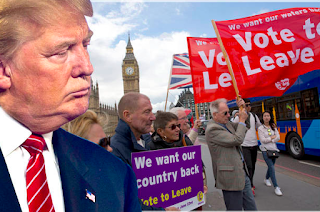
Yet, as I watched the returns well into Wednesday morning, the one recurring thought I had was that we were watching an American version of last summer's stunning referendum on British membership in the European Union (my post on that, here). In my mind, Tuesday's American Brexit is a blow to postwar liberalism equivalent to a warship being fatally torpedoed below the waterline. In some quarters, all of this will be celebrated as an appropriate
shake-up of the status quo. Uncertainty and chaos be damned, a changing of the guard was long over-due.

Perhaps. Fortunately liberalism is not a warship, but a set of ideas whose foundations and loudest purveyors were in need of a shake-up (something I've written about here). Buckle up, the shake-up has begun. The Economist, long a bastion of liberalism, made much the same argument in its reaction to Trump's election. I strongly recommend you read the whole piece (linked here). However, the last paragraph sums up our modern world perfectly. I've copied it below:
The election of Mr Trump is a rebuff to all liberals, including this newspaper. The open markets and classically liberal democracy that we defend, and which had seemed to be affirmed in 1989, have been rejected by the electorate first in Britain and now in America. France, Italy and other European countries may well follow. It is clear that popular support for the Western order depended more on rapid growth and the galvanising effect of the Soviet threat than on intellectual conviction. Recently Western democracies have done too little to spread the benefits of prosperity. Politicians and pundits took the acquiescence of the disillusioned for granted. As Mr Trump prepares to enter the White House, the long, hard job of winning the argument for liberal internationalism begins anew.
The Economist, Print Edition, November 12, 2016.


Monday, 7 November 2016

Peering into the November 9th Abyss...

One of the things I frequently ask my students to do on the first day of class every semester is to recall their moment of political consciousness; that point in their lives when they genuinely take note of the world around them. For me, it was 1979 and the Iranian Revolution and ensuing the seizure of the U.S. Embassy in early November of that year. On nearly every morning that followed for the balance of that crisis (444 days, in fact), I sat transfixed with my bowl of Wheaties in front of Good Morning America trying to sort out what was going on. 1979 turned into 1980 and the Presidential Election campaign that brought Ronald Reagan to the White House in January 1981. The American hostages were released the same day Reagan was sworn into office.

It was a ray of hope for a country that seemed to be on a losing streak; the economy best with "stagflation" (stagnant GDP growth coupled with high inflation), the ever-present threat of oil price shocks, uncertainty about America's place in the world, and the lingering effects of Watergate and the Nixon years.

The 2016 Presidential Election Campaign has been a different ball of wax. There have been tense, consequential, contests in the past, at least one of which (2008) actually generated a bit of euphoria. There year, there's no "Morning Again in America," no "It's the Economy, Stupid," no "Change We Can Believe In," nothing. Sadly, Trump's signature "Make America Great Again" has been underwritten almost entirely by a message of fear and loathing rather than hope and change.

No matter who wins, I am worried about what comes next. The next four years are going to be rough.

Saturday, 22 October 2016

Brexit, CETA and the beginning of the...

Update: Prime Minister Trudeau went to Brussels this past Sunday (October 3) for the public signing of the CETA. He did so after EU officials reached a compromise (Joint Interpretive Declaration) with the refusenik Walloons that sought to calm anxieties about how CETA would be interpreted and implemented. An important concession made outside the JID means Belgium will be able to seek an "opinion" from the European Court of Justice on the legality of parts of the CETA. Although such an "opinion" has been said by EU officials to be non-binding, the political impact on the ratification of CETA by all 28 member governments could be significant. Stay tuned.....

For much of the past two weeks, I have been taking in the sights, sounds, and tastes of the area around Frankfurt, Germany. It's been awesome. This is my second trip to Germany in the last few years, the previous trip being to Berlin. In fact, the photo of the Brandenburg Gate that forms the masthead of my Twitter page is from that trip. Germany regularly captures my attention because of its role in the postwar European Project, but has done so in recent years because of the prominent position it now awkwardly occupies in that Project.

On a light standard in Mainz, Germany
It is a Project that has been fraying around the edges and is, in my mind, a grim warning shot across the bow about where the politics of the global economy are headed.

The television in my hotel room has a surprising number of 24-hour news channels, including the English-language BBC and SkyNews. Yet, the language in which one watches doesn't matter, the news is all about the European Summit and the CETA-- the Comprehensive Economic and Trade Agreement between Canada and the EU.

Regardless of the language in which I watch, it's easy to tell the news is bad.

A week ago, the tiny Belgian enclave of Wallonia (2.5 million people) spiked seven years worth of negotiations between the European Union (500 million people) and Canada by rejecting the terms of the CETA.

There's been a lot of this sort of rejection lately; the Greek debt crisis (which I've written about here a fair bit), to the near-miss of the 2014 Scottish Referendum, the economic nationalism of the U.S. presidential campaign, and, of course Brexit. There are days on which the drum-beat of bad news seems like the beginning of the end....


Thursday, 20 October 2016

I'm for Hillary,.... but it wasn't easy.

I'm voting for Hillary Clinton on November 8....

A lot of readers of this humble blog may be he horrified it's taken me this long to make the obvious choice. Just to reiterate; both the major party candidates suck (to use non-scholarly assessment terminology). One sucks more than the other, but they both suck. Each sucks in different ways, but they both still suck.

And, because they do, I'm also worried about what comes after November 8. Let me explain....

Tuesday, 27 September 2016

Debating the Debate Among Your "Friends"

If you are a political junkie, I know exactly where you were last night! The Super Bowl of politics just had it's first playoff game, and it was great. There is no stage quite like a Presidential Debate.
Pesky pre-rumble formalities
Say what you like about Trump or Clinton as candidates (which I have done on this blog), I have enormous respect for anyone with the guts to get up there and put it on the line. Indeed, I am reminded of President Theodore Roosevelt's famous lines about simply being in the arena:
It is not the critic who counts; not the man who point out how the strong man stumbles, or where the doer of deeds could have done them better. The credit belongs to the man who is actually in the arena, whose face is marred by dust and sweat and blood; who strives valiantly; who errs, who comes short again and again, because there is no effort without error and shortcoming; but who does actually strive to do the deeds; who knows great enthusiasms, the great devotions; who spends himself in a worthy cause; who at the best knows in the end the triumph of high achievement, and who at the worst, if he fails, at least fails while daring greatly, so that his place shall never be with those cold and timid souls who neither know victory nor defeat.
Theodore Roosevelt, "Citizenship in a Republic." Delivered at the Sorbonne, Paris, France, April 23, 1910.
That said, respect doesn't make me a fan. I still wish I had another option. What's bugging me today however, is the debate over the debate.

Redefining the Floor....Down

I was scrolling through some YouTube clips the other day and came across the great Seinfeld episode in which Frank Costanza invites Seinfeld...